
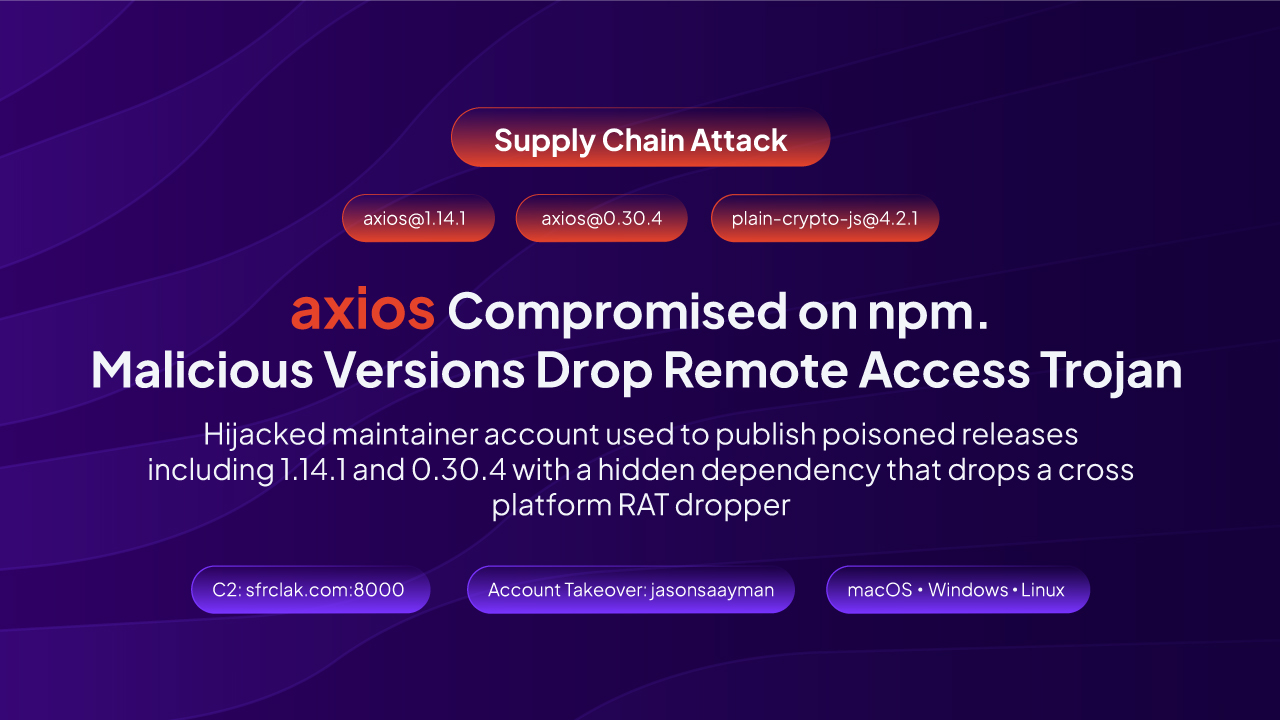
A precision supply chain attack has compromised axios, one of the most widely used JavaScript HTTP client libraries, with malicious versions published directly to npm's official registry. Supply chain attacks target software dependencies to infiltrate multiple organisations simultaneously through a single compromise. According to reporting from StepSecurity, threat actors published axios@1.14.1 and axios@0.30.4 containing a hidden dependency that deploys a cross-platform remote access trojan (RAT) across infected systems.
This represents among the most operationally sophisticated supply chain attacks documented against a top-10 npm package. UK organisations running JavaScript applications, CI/CD pipelines, or automated deployment systems face immediate exposure as compromised installations enable data theft, credential harvesting, and lateral network movement.
Key Facts:
- Two malicious axios versions (1.14.1 and 0.30.4) published to official npm registry
- Hidden dependency deploys cross-platform RAT malware on infected systems
- Axios ranks among top-10 most downloaded npm packages with millions of weekly installations
- Attack enables data theft, credential harvesting, and lateral movement across enterprise networks
How the Attack Exploited Development Trust

The attackers demonstrated sophisticated understanding of software development workflows by publishing versions that appeared legitimate within axios's release pattern. Rather than replacing the entire package, they injected a malicious dependency that activated during installation, making detection significantly more challenging than traditional malware distribution methods.
This precision approach exploited the implicit trust developers place in package registries and automated dependency management. UK organisations using modern JavaScript frameworks, particularly those with automated CI/CD pipelines, became vulnerable the moment their systems pulled these compromised versions. The NCSC has previously warned that software supply chain attacks pose particular risks to organisations with automated deployment processes, as malicious code can propagate rapidly across multiple systems without human intervention.
What Enterprise Teams Must Do Immediately
UK organisations must audit their JavaScript applications and CI/CD pipelines for axios installations matching the compromised versions. Development teams should implement package pinning to prevent automatic updates to dependencies and establish verification processes for critical packages before deployment.
Enterprise security teams need visibility into their software bill of materials (SBOM) to identify potential exposure points. This attack demonstrates why organisations cannot rely solely on package registry security, particularly given the increasing sophistication of nation-state actors targeting software supply chains. Similar attacks against popular packages like Trivy have already weaponised DevSecOps tools, highlighting the systematic nature of these threats.
Boardroom Questions
- Do we maintain a complete software bill of materials for all applications and can we identify axios usage across our estate within 24 hours?
- What automated controls prevent compromised dependencies from reaching production systems and how do we verify their effectiveness?
- How quickly can our development teams respond to supply chain compromises and what is our process for emergency dependency updates?
Quick Diagnostic

- Can you identify all JavaScript applications and their dependencies across your organisation within four hours?
- Do your CI/CD pipelines automatically verify package integrity before deployment?
- Have you implemented dependency pinning to prevent automatic updates to critical packages?
Related Reading
TeamPCP's Audio Steganography Attack Hides Malware Inside 740K-Download Python Package — Supply chain attackers compromised the Telnyx PyPI package, embedding credential stealers inside WAV audio files to evad
Popular Security Scanner Trivy Weaponised Against UK DevSecOps Teams in Supply Chain Attack — Attackers compromised Aqua Security's widely-used Trivy vulnerability scanner on March 19, injecting credential-stealing
GlassWorm Malware Abuses Extension Dependencies to Target UK Developers — GlassWorm supply chain attacks evolve to exploit VS Code extension dependencies, with 72 new malicious extensions target
86% of UK Businesses Don't Check Supplier Security — NCSC data reveals alarming security gaps as supply chain attacks surge 50%, with manufacturing firms particularly vulner
ChatGPT's DNS Data Leak Shows Why UK Enterprises Need AI Vendor Security Audits — Check Point Research exposed a DNS vulnerability enabling silent data extraction from ChatGPT conversations, highlightin
Strengthen your organisation's security posture